
Enquiries, offers and pricing
Prepare offers with meeting spaces, accommodation, meals and services. Reuse customer agreements and templates, track offer status and carry accepted details into the booking.
SOFTWARE FOR CONFERENCE HOTELS
YMER connects the commercial and operational work behind a conference stay. Enquiries, bookings, guests, bedrooms, team assignments and billing belong to the same process, from the first request to customer follow-up.
Prepare offers with meeting spaces, accommodation, meals and services. Reuse customer agreements and templates, track offer status and carry accepted details into the booking.
Coordinate dates, meeting rooms, breakout spaces, catering and equipment. Give planners and organisers a structured way to complete the event details and manage revisions.
Collect participant information through customer and registration forms. Connect rooming lists, bedroom allocation, arrivals and departures to the conference booking.
Connect event and guest-room tasks with staffing, rosters and the employee portal. Give each team a clear view of its responsibilities and coordinate handovers through the day.
Review booking items, costs, additions and commissions before invoicing. Follow offer progress, revenue and utilisation to understand the business beyond an individual event.
Bring contacts, agreements, event history, messages and feedback together. Use personalised templates and shared customer context to support each event and the next booking.
The YMER Planner
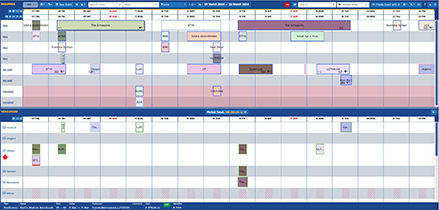
The planner’s Gantt view gives the hotel a common view of the resources behind each conference: meeting rooms, breakout spaces, accommodation, equipment and the services that make the programme work. Sales and operations can review provisional and confirmed arrangements in context, rather than assemble availability from separate calendars. A conference can involve several spaces and several days; keeping those allocations with the event makes it easier to understand what is required and which other bookings need to be considered when the plan changes.
Detailed planning connects the programme with meal times, room layouts, service requirements and tasks. When a group changes its schedule or adds a session, the responsible team can review the effect on rooms, catering, equipment and staffing from the booking context. Tasks and staff assignments give that work an owner, while the conference schedule provides the timing. This supports a more precise handover between the person selling the event and the teams preparing and delivering it.
The timeline shows event duration and colour-coded statuses, including events not yet invoiced, unpaid bookings and cancellations. Event type, costs and VIP notes remain available alongside the plan, and search by date, type or keyword helps colleagues find the right booking. Gantt and table views cover events, bedrooms and staff, making gaps and conflicting allocations easier to see.
For management, the same resource context also matters commercially. A busy diary should be understood alongside bedroom demand, service requirements and utilisation, so decisions reflect the whole conference rather than the meeting room alone.
The customer portal
After a conference is confirmed, a substantial amount of work still sits with the organiser: final numbers, the programme, participant information, meals, activities and accommodation. The customer portal gives that collaboration a place within the event. Organisers can provide planning information and manage the participant and session details available to them, while the hotel keeps the work connected to the booking. The conversation can move forward without relying on a succession of unrelated email attachments.
A late programme change may affect a room layout, a coffee break and the staff needed at a particular time. Structured detail planning helps the hotel see the change in its event context and coordinate the next actions. The organiser contributes the information they know; the hotel retains responsibility for availability, commercial decisions and delivery. Returning customers can also start suitable requests from a structured form, reducing the clarification needed before an offer can be prepared.
Organisers can create, change or remove activities and sessions, adjust timings and connect participants and resources to the programme. They can review and approve menus and update room configurations within their access. Changes are reflected immediately in the hotel’s operational view, so the customer’s latest plan remains connected to the work of the venue.
This is useful for both sides of the relationship. The customer has a clearer way to supply the required details, and the hotel spends less effort transferring those details into its own plan and explaining the same arrangements to different teams.
Room management and reception
Bedroom management belongs alongside conference planning. YMER gives reception and planners a room timeline with bookings, room categories, individual room details and guest assignments. Group accommodation can be reviewed against arrival and departure dates, with the rooming list connected to the event. When one delegate arrives early or a group extends its stay, the team can work through the accommodation change in the context of the conference and the other rooms already committed.
Follow check-in and check-out, allocate guests to rooms and organise the tasks associated with their stay. Room attributes help with suitable assignments, while booking details retain the services and payer arrangements that matter at reception and during billing. Room preparation and housekeeping tasks sit within the operational workflow, so reception and the teams responsible for the rooms have a common basis for their handover.
Room categories, such as standard, deluxe and suite, retain their amenities, capacities and prices. Allocate accommodation automatically against availability and guest preferences, or assign rooms manually where the group needs a particular arrangement. Guest requests, room assignments and check-in and check-out details stay together, with current arrival status available to reception.
This gives the hotel a joined-up view of the visit: the event being delivered, the people attending, where they are staying and the work needed around them. It also makes accommodation part of the commercial conversation from the first offer.
Staff management and the employee portal
An event programme is also a staffing plan. Rooms need preparing, meals need serving and guest arrivals create work for reception and room teams. YMER connects these requirements with tasks, staff assignments and rosters, giving managers a view of the work alongside the people available to deliver it. Employee profiles, qualifications and training help teams organise responsibilities, while days off and shift patterns provide the context for a workable schedule.
The employee portal brings together personal schedules, assigned tasks and days-off information. Staff can see what they are responsible for and update task progress, while managers coordinate the event and guest-room work from the same plan. Roster templates support familiar working patterns, and the demand view helps the team assess busy periods and changes to the programme. A larger dinner or an earlier arrival can be considered together with the work it creates.
The result is a closer connection between what sales has promised and what the hotel team needs to do. Responsibilities are easier to hand over, and managers spend less time assembling the daily picture from separate schedules and task lists.
Communication and documents
Conference communication continues from the first offer to the final thank-you. YMER brings reusable email, SMS and document templates into that workflow, with customer and event information available for personalisation. Teams can prepare confirmations, planning requests, participant information and follow-up messages from a consistent starting point, with language variants for different audiences. Brand and wording stay coherent while each message reflects the actual booking.
Message history keeps the context available when another colleague takes over. Templates reduce repeated drafting, and their saved versions make it easier to manage changes to standard wording. Event documents and attachments stay close to the work they support, whether the team is sending an offer, collecting the remaining details or following up after departure. The organiser receives communication that relates to the stage their event has reached.
Presentation and offer templates can include slide layouts and multimedia, alongside reusable text for invitations, confirmations and follow-up. Adapt colours, fonts and logos across proposals, emails and the customer portal to reflect the hotel’s own identity. The same brand can carry through the customer’s first enquiry, detailed planning and subsequent communication.
For the hotel, this means less time recreating routine messages and finding earlier correspondence. For the customer, it creates a more consistent experience across sales, planning and delivery, even when several people are involved.
Reporting, costs and invoicing
A complete view of conference business needs more than an occupancy calendar. YMER brings together the offer pipeline, booking progress, revenue, costs and resource utilisation so managers can see how sales activity translates into business for the hotel. Look at trends over time, review the value of individual events and use exports for further analysis. The same booking context connects meeting-space revenue with bedrooms, food and the additional services sold around the conference.
Prepare invoices from the booking and its service lines, allocate charges to the appropriate payer and review additions, discounts and commissions before finalising the documents. Invoice status gives the team a view of what has been created, sent, is due or has been paid. Customer agreements, date-based prices and cancellation terms support consistent handling from the offer through to reconciliation, with accounting exports and connections fitted to the hotel’s workflow.
Track operating costs such as utilities, staffing and maintenance as the event budget develops. Identify events and services that have not yet been invoiced, prompt the team to prepare billing, and follow unpaid invoices by due date. A searchable archive retains issued, paid and outstanding documents for reconciliation and audit. Partner commission statements can be compiled and distributed automatically.
This helps commercial and operational teams work with the same figures. Managers can investigate quiet periods, outstanding billing and the contribution of different types of business, while the people handling an event can see the detail behind its totals.
Multiple hotels and venue management
YMER supports the needs of an individual conference hotel and the coordination of several venues. Give users access to the hotels they work with and let them move between venue contexts, while each property retains its rooms, resources, customers and operational setup. This makes it easier for colleagues supporting more than one location to use a familiar workflow without losing the local detail that determines how an event is sold and delivered.
Use a consistent approach to offers, planning, communication and follow-up across the organisation, with templates, language choices and responsibilities suited to each hotel. Venue-specific prices, packages, schedules and working practices keep the operation relevant to the property. Managers and staff work in the context they need, with user access reflecting their responsibilities.
The value is continuity: a recognisable process for teams working across locations, a coherent customer experience and enough flexibility for each venue to run its own conference business.
A complete suite in your hotel
Conference work often sits between several tools: an enquiry inbox, a proposal application, planning spreadsheets, participant lists, task boards and systems for bedrooms and billing. YMER brings this work into a shared suite, carrying the booking through sales, guest arrangements, team coordination and financial follow-up. Your hotel gains a consistent process with less repeated entry and clearer handovers, while the systems you choose to retain connect to that workflow.
Implementation starts by reviewing the venue’s rooms, resources, articles, packages, customer terms, forms and working practices. Together we identify the information to bring across, responsibilities for maintaining it and any connections needed to systems the hotel will retain. Accounting, payment or other hotel-system connections are assessed individually. The setup is then checked against representative events, including a residential conference and a change to its requirements, before the team moves into daily use.
Standard APIs connect YMER with invoicing and accounting tools, booking partners, payment processors and property management systems. Agreed connections can import partner bookings, exchange participants, resources and prices, export billing data and synchronise room availability in real time. Participant workflows can also connect to Tropus. Custom integrations support specialist or internal systems, with the data, direction and timing of each exchange defined for the hotel.
That makes a presentation a practical discussion about your operation. We can follow an enquiry through the suite, identify where separate tools and manual handovers are being used today, and agree the configuration and integration work needed for your hotel.
AI
For repeat customers and templated events, YMER can prepare and send responses automatically within the rules you configure. AI helps turn plain email enquiries into structured information. Requests outside the agreed scenario can go to an employee for review and approval.
Configure eligibility, prices and approval requirements for each scenario.We start by mapping your current tools, data and workflows. Together we identify what YMER can consolidate and which connections you still need. Accounting, payment and existing hotel-system requirements are assessed during scoping; compatibility is confirmed for your setup.
Map enquiry sources, booking stages, existing tools and responsibilities. Identify the information each department needs and the manual work you want to reduce.
Agree how rooms, packages, rates, templates and user responsibilities should be set up. Review customer data and the accounting, payment or hotel-system connections that need to be retained.
Work through representative bookings from offer to billing. Agree training, rollout responsibilities and support arrangements before introducing the new process into daily operations.
Hotels where conferences, meetings and events drive the business, and where sales and delivery need to work closely with guest and bedroom management.
YMER connects the full conference-hotel operation: enquiries, offers, bookings, planning, participants, bedrooms, staff, communication, billing and customer follow-up. The information your team needs stays connected throughout the event.
No. Automatic responses are for configured scenarios such as repeat customers and templated events. Other enquiries can use AI assistance with employee review and approval.
YMER brings enquiry handling, offers, planning, guest management, staff coordination, communication and billing into one suite. We help you consolidate these tools and connect the systems you choose to retain.
Arrange a live presentation based on the way you sell, plan and deliver conferences. We will discuss your current systems, show the relevant workflows and review the scope of a possible implementation.
Book a presentationProduct development and conference expertise, with clear responsibilities for implementation and support. Speak with Konflinx or our Nordic partner, Kontur Konferens, about your hotel’s requirements.

Konflinx AB develops and owns the YMER platform. We take responsibility for the product and its technical operation, working with the hotel on the capabilities and connections its conference business needs.

Kontur Konferens is a co-owner of Konflinx AB and YMER’s general agent in the Nordic countries. As a reseller and integration partner, it supports venues in Sweden, Denmark and Norway with sales, implementation and day-to-day support, drawing on its experience in conference planning.